

The Missing Piece in Mental Health
What Modern Neuroscience Is Revealing About the Connection Between the Brain, Body, and Nature
On a sweltering day, you walk through the doors and slam into the invisible wall of air conditioning. Inside, the clinical atmosphere abounds in the white walls, generic landscape prints, and the rustle of papers at the front desk. Back in the office—after stepping onto a scale to measure the increased gravitational pull since last visit while averting your eyes from the numerical result, the blood pressure cuff cutting off arterial flow through your left arm, and circling the numbers that supposedly quantify your current level of distress—the doctor then suggests a medication with a name that sounds like a complex organism you once learned about in biology class. “Is there a more natural method I could try first?”
Many people have become wary of modern medicine, as they’ve tried multiple medications unsuccessfully in the past, or feel pressured into believing there is one special pill to cure all their ailments, or simply have a sense that modern medicine is unnatural. I don’t think it’s as simple as people being resistant to change or ‘stuck in the dark ages.’ There seems to be an innate human longing to heal our bodies naturally. After all, aren’t our bodies designed and evolved to function effectively in the world?
Disclaimer: Healthcare and treatment decisions, natural or otherwise, should always be individualized and in collaboration with a medical professional. This blog is educational and is not medical advice.
The desire for a natural explanation for our human experience seems to be intrinsic to humanity. The brain has always fascinated me, in part because no one can quite describe it. Descriptions of the brain, cognition, and consciousness always fall short of the lived experience of being. It feels highly unnatural that our brains function as computers, but this is the dominant description in anatomy and physiology and pharmacology textbooks. The brain is described in terms of neural networks and processing circuits. I can’t help but wonder, are we describing the human brain or humanity’s latest technological achievement—the computer?
I surely can’t be alone in this—it’s always made me uneasy that people are so quick to accept that AI technology is developing consciousness. Consciousness has to be more than some complex neural networks, right? Debates over AI consciousness are ongoing. It’s in the news about every day. It feels unnatural. I wonder if these debates over AI the danger of AI’s increasing intelligence and potential consciousness are based more on reality or… marketing. I don’t have experience studying AI technology, so I’m not claiming to be an expert. However, I do have experience in studying the brain, and there are far more questions than answers. So… how are some so sure that newly developed AI technology is developing consciousness when we don’t even understand the cause of consciousness in the human brain that has been studied for millennia?
Western medicine has achieved leaps and bounds for overall health. These advancements have lengthened and improved the quality of life for so many, from the development of antibiotics to cardiac pacemakers to advanced CT/MRI imaging. However, Western medicine’s computer-centric understanding of the brain seems to be lagging behind the advances made for the rest of the physical body, as if there is a puzzle piece that is missing.
A 2026 study was published in Cellular and Molecular Neurobiology that uncovered new evidence that could help find that missing piece. The study findings may be the first step toward understanding the current neuronal network-focused neuroscience as a more flow-focused science. Flow sounds a bit woo-woo, right? The groundbreaking study identified a new connection between cerebrospinal fluid (CSF) and the lymphatic system in humans. Until now, the brain was thought to be completely closed off from the rest of the body, and the CSF ‘waste’ was simply drained into the bloodstream. This new connection opens up possibilities that may explain the brain’s connection to other body systems, including the immune system and major organ systems. In an interview on Breaking Points, one of the study’s authors, Shalin Bhatt, describes the lymphatic system as a highway for immune cells connecting major organs such as the spleen and gut-associated lymphatic tissue. The well-establiished gut-brain connection comes to mind and could be further explained by central nervous system connections to the lymphatic system. Could this discovery reveal the brain’s connection and role throughout the body?
Eastern medicine has long focused on energy and flow in the body. Seems like Eastern medicine may have been onto something. This new connection may fill in the missing piece in Western medicine’s understanding of brain function.
The brain is surrounded by cerebrospinal fluid within the skull. Fluid contains ions that create electromagnetic fields, which could theoretically impact neuronal function. Could these electromagnetic fields influence consciousness? This may answer the question of consciousness beyond neural networks. Flow through the brain and body via this newly identified connection is an exciting new theory of consciousness. This theory also implies that AI isn’t conscious… at least not yet… because consciousness is more than neuronal networks and circuits.
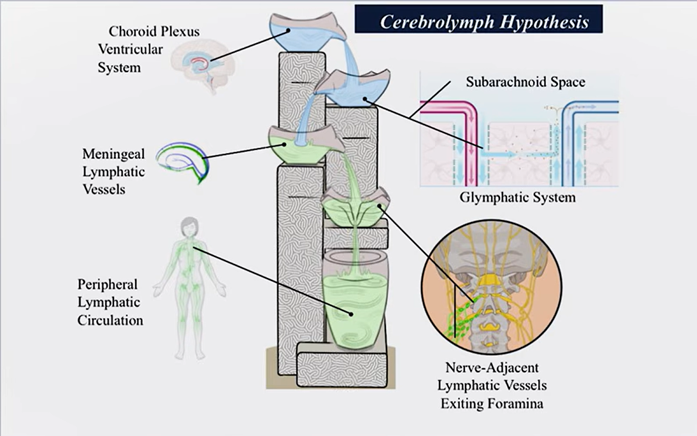
This 2024 article from Proceedings of the National Academy of Sciences (PNAS) describes how the brain expands and contracts with every heartbeat, essentially acting as a pump within the skull. Theoretically, this rhythmic movement of the brain is sufficient to drive CSF out through the microscopic lymphatic vessels at the base of the skull. Their small size makes these lymphatic vessels extremely difficult to study in humans, with surgery being termed ‘microsurgery.’ While these mechanisms have largely been theoretical, researchers have now identified a physical connection between the brain and the lymphatic system, providing direct evidence for this pathway.
The Cerebrolymph Hypothesis models the connection between cerebrospinal fluid (CSF) and the peripheral lymphatic system. The 2026 study discussed above, which identified a physical connection between these systems, supports the Cerebrolymph Hypothesis. This model clearly describes the theoretical mechanisms linking the brain’s CSF and the body’s broader lymphatic circulation. The image below illustrates the Cerebrolymph Hypothesis and the specifics of this proposed pathway.
This discovery has implications beyond explaining consciousness. It may also help explain why exercise and mindfulness meditation promote health and wellness. Physical movement promotes blood and lymphatic flow throughout the body, improving CSF waste drainage, which may explain the cognitive and mental health benefits of exercise. Mindfulness meditation has also been proven to promote CSF circulation and is linked to overall brain health.
Science almost seems to be coming full circle back to medieval medicine, as it was believed that body ‘humors’ or fluids must be kept in balance to achieve a healthy body and mind. It was thought the best way to do this was through diet, exercise, sleep, and managing emotions. Though medieval people didn’t have access to modern medicines, doctors largely focused on the mind-body connection. Melancholiacs—or depressed people—were thought to be suffering from an excess of black bile, which obscured rational thought. Doctors addressed this by purging the black bile by increasing body heat, using syrups made with warming ingredients such as cinnamon, or massaging with warm oils. It was taught that these treatments worked best when combined with lifestyle changes, so patients were also encouraged to exercise, socialize, and do activities they enjoyed.
Medieval doctor Taddeo Alderotti treated Obizzo II d’Este, lord of Ferrara (c1247-93), who suffered from melancholy and insomnia for more than two years, and his prescription included ‘taking walks … seeing things that are beautiful and delightful to him … hearing songs and instruments that he likes’. Still today, natural interventions like diet and exercise are known to promote both mental and physical health. A review of recent literature explains the “endorphin hypothesis”, which describes how physical activity causes the brain to produce more endogenous opioid peptides, reducing pain and boosting mood. This makes logical sense, but is it the whole story?
Recent studies show that regular engagement with the arts can improve both our physical and mental health, and medieval people shared this belief. Reading was widely encouraged to promote overall health and well-being. The outdoors and nature were also believed to have significant benefits for both physical and mental health. For example, monks dealing with melancholia were encouraged to take long walks, and wealthier monasteries often owned multiple properties where exhausted monks could ‘benefit from a change of air and surroundings’. Medieval people recognized the health benefits of gardens, which provided sensory stimulation from greenery, floral aromas, and birds chirping, as well as opportunities for exercise and relaxation.
“For then a man is exposed to wholesome air, and he rejoices in gazing far and near, and upon the sky, the sea and the green landscape; and he is therefore constrained to commend, to praise, and to magnify the Lord his God. Exercise therefore is good, since … it unites a man to his Creator.” -London-based 15th-century medical writer John Mirfield
The science may finally be catching up to what human wisdom has long recognized: natural interventions promote both mental and physical health. Medication always works best alongside healthy daily habits. Whether through physical exercise—such as walking like the melancholic monks—spending time outside, feeling the sun on your skin and enjoying the sensory experiences of nature, or eating nutritious foods to fuel the brain and body, these natural, everyday habits support physical and mental health. Modern Western medicine has given us power over illnesses that were once debilitating, even deadly. Yet it has taken a bit longer to scientifically investigate and understand the wisdom of nature in our bodies and the benefits of practices people have relied on for hundreds of years. Science has now revealed a brain-body connection that may help explain these natural remedies. Mental health is best understood holistically, combining advances of modern medicine with knowledge and practices passed down through generations across the world. It is best not to forget, after all, that anxiety and depression are not a modern fad, but an enduring part of the human condition.