

Need a Little Hygge This Winter?
Learn about seasonal depression and practical ideas from around the world.
If winter makes you want to crawl under a blanket, sleep until spring, and cancel every social plan on your calendar, you’re not alone.
Winter has a profound effect on the mind and body. Shorter days and reduced sunlight can influence sleep, energy levels, appetite, social connection, and overall mood. For some people, these changes can develop into seasonal depression, or as the medical community calls it—seasonal affective disorder (SAD)—what an acronym, right?
In this article, I’ll break down what seasonal depression actually is, how to recognize the signs, why some people are more vulnerable, and what you can do to support your mental health during the darker months. We’ll also explore a surprising insight from across the globe and how creating more coziness, connection, and enjoyable routines might help us approach winter a little differently.
So, what exactly is seasonal depression? And how is it different than ordinary depression?
Seasonal depression is a form of depression that occurs in seasonal episodes. In a 2022 interview, Dr. Jade Wu, PhD, DBSM, a researcher at Duke University School of Medicine, pointed out that the main difference from ordinary depression is a clear seasonal pattern. There is actually both winter and summer seasonal depression; however, winter is much more common and researched. This article will focus on winter seasonal depression. Winter seasonal depression starts in the fall, peaks in December, and ends in the spring. The episodes of seasonal depression usually last about 4 months. In ordinary depression, the episode can be as short as 2 weeks, so a seasonal episode is usually much longer.
What symptoms should I look out for?
Since it is a subset of depression, the symptoms of depression will be present, along with a few that are specific to seasonal depression.
Symptoms of depression:
- Feeling sad, hopeless, or “empty” most of the day, nearly every day, for at least 2 weeks
- Feelings of irritability, especially in children and adolescents
- Loss of interest or pleasure in hobbies and activities you used to enjoy
- Loss of energy, fatigue, or feeling slowed down
- Difficulty concentrating during the day
- Thoughts of death or suicide
Symptoms specific to seasonal depression:
- Oversleeping
- Overeating—craving for carbohydrates, potential weight gain
- Social isolation— “hibernating”
What are the Risk Factors?
- Genetics: A genetic component has been confirmed by studies that show melanopsin gene variations causing the retina to be less sensitive to light, leading to changes in activity levels and sleep timing in the winter.
- Women and young adults
- Co-occurring psychiatric conditions: such as anxiety or attention-deficit/hyperactivity disorder.
- Individualistic societies: This study found a correlation between seasonal depression and individualistic societies (Australia, Britain, the U.S.).
- Being a night owl: AKA- having a “late chronotype” increases risk for any depression, likely due to a misalignment with social responsibilities, which is terrible for mood.
- A Western time zone: People who live in more western areas experience less daylight exposure.
What is actually happening in the body?
Serotonin is the feel-good chemical in the brain and body, highly associated with depression and other mental health issues. Serotonin levels fluctuate seasonally for everyone. However, people with seasonal depression have higher fluctuations between summer and winter, which means they spend more time in a more extreme “winter mode.”
Serotonin plays a role in regulating melatonin, a hormone that helps control our sleep-wake cycle. During the shorter, darker days of winter, reduced light exposure can affect these systems and contribute to increased sleepiness and fatigue.
We can get vitamin D from certain foods and supplements, as well as from sunlight exposure. Because there is less daylight during the winter, some people may have lower vitamin D levels. Vitamin D also plays a role in serotonin activity, which may further influence mood and energy levels.
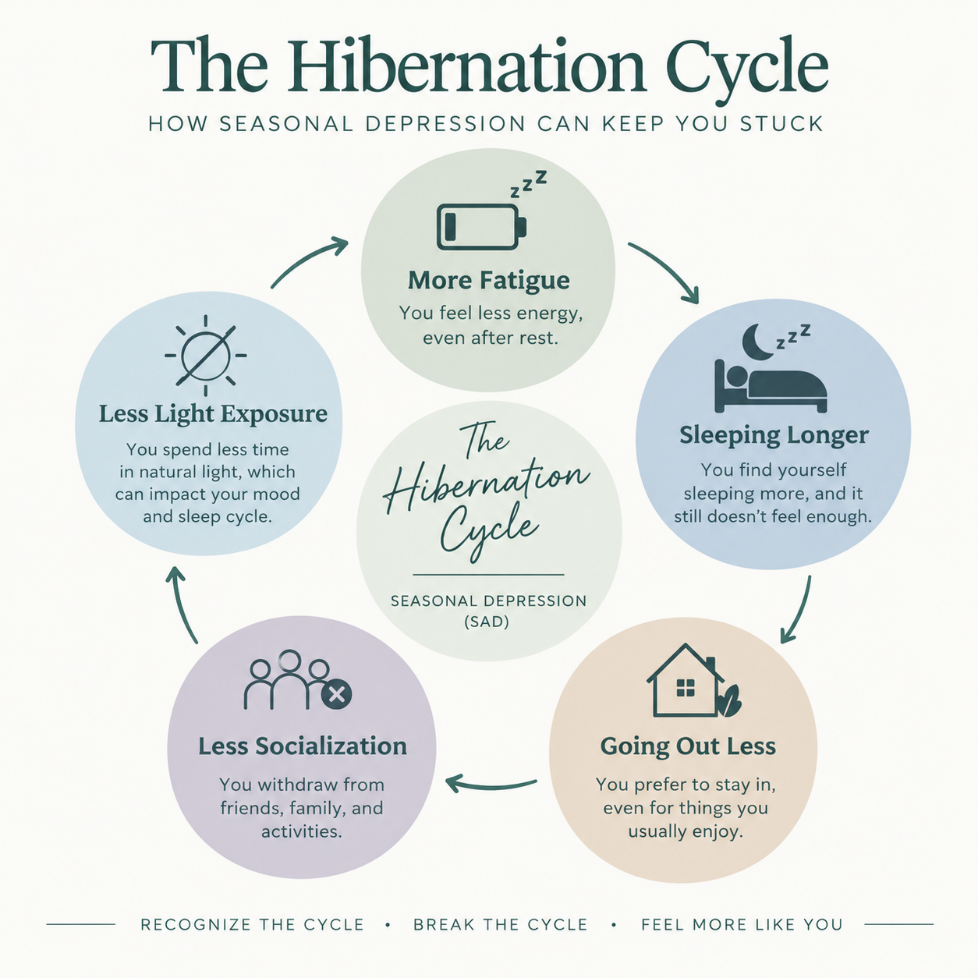
Basically, it’s all connected and easily turns into the “Hibernation Cycle” of more fatigue, sleeping longer, going out less, less socialization and activity, and less light exposure that feeds itself and compounds symptoms of seasonal depression.
Treatments for seasonal depression:
- Light therapy is moderately effective when used in the morning. You can read, eat, or use a laptop while near it.
- Cognitive-behavioral therapy (CBT) often includes light therapy and focuses on daily habits and sleep patterns, as well as cognitive patterns associated with seasonal depression.
- Medication may be considered after discussion with a healthcare professional.
Turns out CBT has a longer-lasting effect than light therapy long-term, which is thought to be due to lasting healthier habits.
Habits to support mental health during the winter:
- Light exposure in the morning: especially sunlight exposure helps regulate the sleep-wake cycle
- Minimize light exposure at night: putting devices in “night-shift mode” and using blue light glasses in the evening can be helpful
- Exercise: activates your body during the day and releases endorphins that boost mood
- Socialization: loneliness and low social support are strongly associated with depression and anxiety symptoms.
- Getting up at the same time every day: oversleeping and napping disrupt the circadian rhythm
- Scheduled naps if needed: limit naps to 30-45 minutes to promote better sleep at night and avoid spending time in bed during the day
Most research on seasonal depression has focused on the Northern Hemisphere, where it becomes more common at higher latitudes. It becomes more common farther from the equator, with rates as low as 1% in the Philippines and as high as 10% in Denmark.
Wait… I thought Denmark was one of the happiest places in the world. Yet, it has one of the highest rates of seasonal depression?
Despite experiencing long, dark winters and relatively high rates of seasonal depression, Denmark consistently ranks among the world’s happiest countries. So, what are they doing over there?
They’re doing hygge (pronounced “hoo-guh”). Hygge is a part of Danish culture that doesn’t have an exact English translation. The word originates from the 16th-century Norwegian term hugga, meaning “well-being.” Hygge is the practice of promoting comfort, connection, community, and togetherness. For Danes, it’s a mindset centered around appreciating simple, everyday moments and routines. These small rituals can bring warmth and enjoyment to ordinary days while helping people cope with boredom and the cold, dark days of winter.
There’s no one “right” way to practice hygge. Here are a few examples you can adapt to fit your lifestyle, preferences, and what brings you a sense of comfort and connection.
- Relaxing, mood lighting. At home, dim the lights, light some candles, or make a fire in the fireplace (if you have one). Combine this with putting devices in “night-shift mode” and using blue light glasses in the evening to promote relaxation.
- Comfiness. Add warm, soft blankets and pillows to your home to increase coziness. Wear your favorite comfy clothes, socks, or slippers that keep your feet warm. Listen to your body and opt for soft textures that feel good to you.
- Establish a bedtime routine and cozy space. Cuddle up with some hot tea, wrap up in a warm blanket, read a chapter to wind down, and make your bedroom the most relaxing place in the house.
- Hang out with a circle of close friends and/or family. Togetherness, where you feel understood and are comfortable sharing your thoughts and feelings, is the essence of hygge.
- Enjoy sweets and treats. Go ahead and enjoy sweets, pastries, hot chocolate, hot cider, and other tasty treats. Hygge is the smell of fresh-baked goods and comfort foods. Roll up your sleeves and bake something delicious at home (by yourself or with friends). Remember, hygge is not only comfort food, but it’s also the enjoyment of the process.
- Mindfulness. Turn off your phone and focus on the present moment. Listen to soothing music, light a candle, and treat yourself to calming scents (lavender, chamomile). Read an enjoyable book or play a fun board game with friends or family.
Hygge is about giving your stressed-out, overachieving self a break with some joy and contentment. Winter doesn’t have to be something we dread until spring. While we can’t control how much daylight we get, we can be intentional about the habits we build in the darker months.
For some, seasonal depression requires professional treatment, such as light therapy, psychotherapy, or medication. For others, small daily habits—getting morning sunlight, staying active, maintaining a consistent sleep schedule, and staying connected with others—can support mental health in the winter.
Hygge isn’t about pretending winter is easy; it’s about finding your own personal way to make the season feel warmer, more connected, and more enjoyable.
You don’t need to completely change your life or follow a strict set of rules. Start with one small routine that feels good and manageable for you. Maybe it’s morning sunlight, coffee with a friend, a cozy bedtime routine, baking something tasty, or putting your phone away to be present and enjoy the evening.
There’s no one right way to practice hygge. The goal is simply to find more ways to bring warmth and connection into the darker months.
Let me know what your version of hygge looks like this winter.
I like the way of your posting. Keep going. I like to visit this informative blog for further updates.
Thanks, I’m glad you are enjoying the blog! You can subscribe to the mailing list to receive the latest blog posts as soon as they are published.