

10 Common Signs of ADHD in Adults You May Not Recognize
Experiences That Often Go Unnoticed and What To Do About Them
Have you ever felt different in a way you couldn’t quite explain? Have you ever wondered if everyone else received an instruction manual for life that you somehow missed? Maybe you’ve spent years trying to understand why certain everyday tasks feel surprisingly difficult, why your mind rarely seems to slow down, or why things that appear effortless for others require so much energy from you.
Social media has sparked conversations about adult attention-deficit/hyperactivity disorder (ADHD), causing many people to reconsider experiences they’ve struggled with for years. After all, how do you know if it’s a symptom of ADHD or simply a relatable human experience? What if you feel exhausted on the inside while everything appears manageable on the outside?
Happy ADHD Awareness Month, everyone! Let’s address some of these common questions and misconceptions to shed some light on what ADHD can look like in adulthood.
Ever since I started studying psychiatry and the Diagnostic and Statistical Manual (DSM-5), I’ve found it interesting that one specific criterion applies to most mental disorders: symptoms must “cause clinically significant distress or impairment in social, occupational, or other important areas of functioning.” It applies to depression, anxiety, obsessive-compulsive disorder, posttraumatic stress disorder, ADHD, autism spectrum disorder, eating disorders, most substance use disorders, among others. In a way, this criterion makes sense—it can be an objective, observable sign of illness. Examples include being unable to hold a job, succeed in school, complete household tasks, etc.
That covers functional impairment, but what about “clinically significant distress”? It’s odd phrasing for a fundamentally subjective and personal human experience. It’s often hard for patients to know how to effectively communicate their distress, especially adults with ADHD, who have learned how to mask their symptoms so they may not appear “clinically significant” even if they cause extreme internal distress.
A child with ADHD may be corrected for blurting out answers, interrupting others, or zoning out in class. Over time, they may learn to hold back their comments, sit quietly, or appear attentive even when their mind has wandered. While these adaptations may help them meet expectations at school, the underlying difficulties remain. Maintaining this outward appearance may require considerable mental effort and energy. In adulthood, when faced with greater responsibilities and less structure, those childhood coping strategies may no longer be enough. What went unnoticed in childhood may become much more apparent in adulthood.
We haven’t had much research on ADHD until fairly recently, so it’s not surprising many adults are now wondering if something was missed in childhood that could help explain their difficulties. The picture below shows that we had about 4 articles on adult ADHD in 1970 and now have thousands.
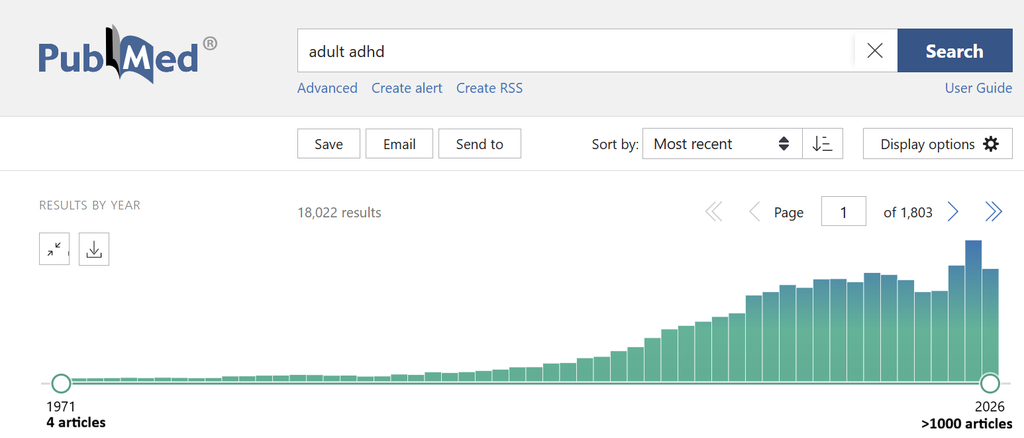
The increased attention and awareness of ADHD online is exciting—I mean, look how far we’ve come since 1970. I understand the desire to explore and search for answers on social media, especially when the current medical system remains inaccessible to many. Many share personal experiences with ADHD that can be extremely valuable. However, we should remember that social media algorithms feed us information to capture our attention and keep us engaged and staring at the screen, not what is most helpful or scientifically validated. A 2022 study found over half of the 100 most popular ADHD videos on TikTok were misleading. Only 21% were classified as useful.
There’s clearly a desire for quality ADHD information and resources. Neurodiversity has received increased attention in recent years. Many attribute this to people having more time for self-exploration during COVID. If so, it may be one of the few good things that came from COVID. Self-exploration can help you better understand yourself and how you interact with the world. It’s also important to have evidence-based information and tools to do so.
Below is a list of ten common experiences of adults with ADHD. If any or all of these feel true to you, you may want to consider checking out the screening test and other resources below.
10 Common Experiences of Adults With ADHD
- Having a constant internal monologue.
You may be shocked to learn that some people don’t have an inner voice. This study found it’s common for people with ADHD to have a constant internal monologue, often described as “a busy brain” or “an internal critic.” The authors suggest that talking to oneself may help people with ADHD stay mentally stimulated or mask ADHD symptoms in certain situations. - Hyperfocusing on things that interest you.
The name “attention-deficit” can be a little misleading. ADHD involves difficulty regulating attention rather than simply having too little of it. You may be able to focus intensely on something that captures your interest while struggling to sustain attention on a boring work or school assignment. - Difficulty shifting attention when interrupted.
This can go hand-in-hand with hyperfocus. When you’re deeply focused on something, switching your attention to another task can feel surprisingly difficult and may lead to feeling frustrated and overwhelmed. - Free time causes anxiety.
When someone tells you to “just take a break,” your brain doesn’t necessarily know how to slow down. You may feel more comfortable with active rest, such as going for a walk or doing an activity you enjoy, such as journaling, drawing, or cooking. - Hating small talk.
Ever have the thought, “ Small talk is the worst”? Do you frequently leave conversations without remembering many of the details? You may think you’re listening, but your mind is actually wandering and only picking up on like 50% of the conversation. On the other hand, if you’re really into a topic or find someone really interesting, you remember every single detail. - Experiencing emotions intensely.
This is often described as emotional flooding, or feeling like emotions will last forever. These can be positive or negative emotions. You may also have trouble describing your emotions to others, which could be a sign of alexithymia—often associated with ADHD. - Being chronically early.
ADHD is often discussed in terms of chronic lateness, but what if you’ve learned to overcompensate? You may find yourself arriving excessively early to everything out of fear of being perceived as irresponsible or inconsiderate. You might even take it a step further, worrying about arriving too early and struggling to understand how other people seem to instinctively know what counts as “on time” in different situations. - Losing things frequently.
Keys, phone, wallet, remote—do you find yourself constantly searching for things you just had? You may also notice that you have built in strategies to help you keep track of things, like having a designated spot for items you would frequently misplace. - Getting lost—physically or mentally.
You may often miss exits or turns when your attention drifts to a song, podcast, or billboard. You may easily lose track of how long you’ve been driving. Getting absorbed in your internal thoughts and losing track of your surroundings is a common ADHD experience. - Cleaning takes forever.
You start cleaning your room, pick up your dog’s toy to bring it into the living room. You notice the shelf is awfully dusty, so you go grab the duster. Oh, there’s a pile of dishes in the sink, so you wash them. Before you know it, you’ve bounced from room to room and task to task—and somehow, you’re cleaning the entire house… halfway.
If you relate to any or all of these, you may want to complete an Adult Screening Test for ADHD. This won’t give you a diagnosis, but it will give you information to help you decide if you want to pursue further evaluation.
For some, self-exploration and self-diagnosis are enough to help explain struggles and reframe some difficulties of daily life. Others prefer to pursue a formal diagnosis. It’s a personal decision based on your own individual preferences and unique experience.
While you’re figuring it all out, I want to share one of my favorite tools to help people manage struggles with focus, motivation, and procrastination. A Dopamine Menu for ADHD is a personalized list of activities to stimulate your brain in moments of feeling overwhelmed or unmotivated. This tool is especially helpful for individuals with ADHD, but it’s useful for anyone who struggles with focus, motivation, or procrastination.
Similar to a restaurant menu, a dopamine menu includes starters, entrées, sides, desserts, and specials. You choose an activity based on what you need to boost your motivation or energy. A dopamine menu is a personalized list of enjoyable, accessible activities that can help you get started, recharge, or refocus when you’re feeling stuck. Learn more about creating your own dopamine menu here.
“Labels do their best work when they help us figure ourselves out in a way that gives us a better way to talk about ourselves, to talk to ourselves, and to recalibrate our expectations for ourselves.”
-Tressie McMillan Cottom
Whether you’re exploring the idea of an ADHD diagnosis for yourself or are thinking of a friend or family member, I’d encourage you to check out this recent New York Times interview discussing self-diagnosis and what it can give us. In the interview, columnist and sociologist Tressie McMillan Cottom and author Mary H.K. Choi — who has written about her own ADHD and autism — discuss what a diagnosis gives a person and how a label can be helpful or limiting.
Maybe receiving a diagnosis would allow you to give yourself more time, patience, compassion, and kindness. It may help you let go of unrealistic expectations and embrace a less perfectionistic version of yourself. It may help you make peace with those who didn’t understand or support you in the way you needed.
The interview leaves us with an important question: Do we need a medical diagnosis to give us permission to be kind to ourselves?
These are all me!
Hi Zach! Glad you could relate to the article and hope you found it useful.